14.2.5. Nonlinear MDOF
The source code is developed by Joseph Jaramillo from National University of Engineering.
The source code is shown below, which can be downloaded
here.The ground motion file
here.And also the python plotting script
here.Make sure the numpy and matplotlib packages are installed in your Python distribution.
Run the source code in your favorite Python program and should see:
Natural periods:       Natural frequencies:
T1 = 0.628 [s]    |    f1 = 1.592 [Hz]
T2 = 0.257 [s]    |    f2 = 3.898 [Hz]
T3 = 0.162 [s]    |    f3 = 6.164 [Hz]
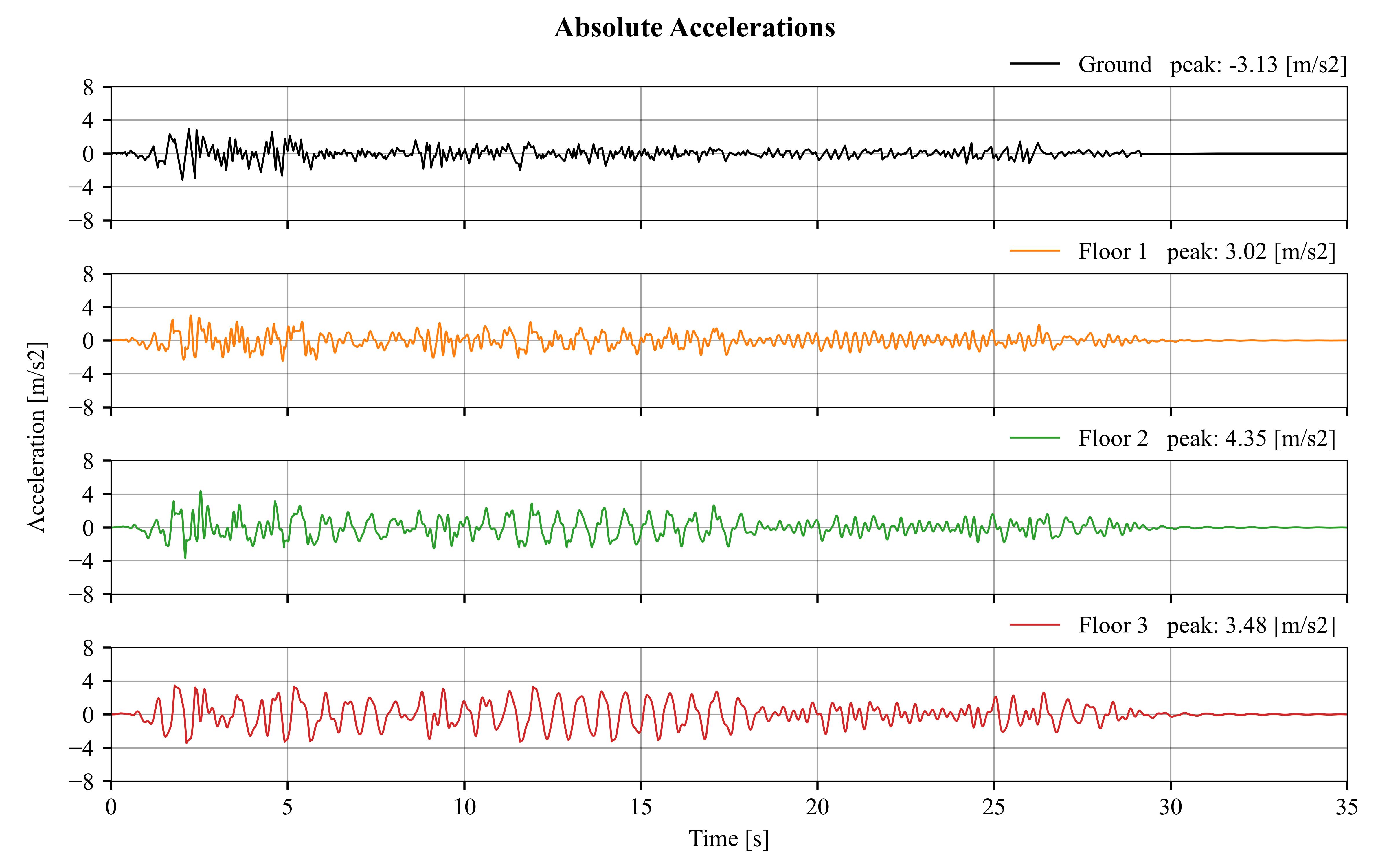
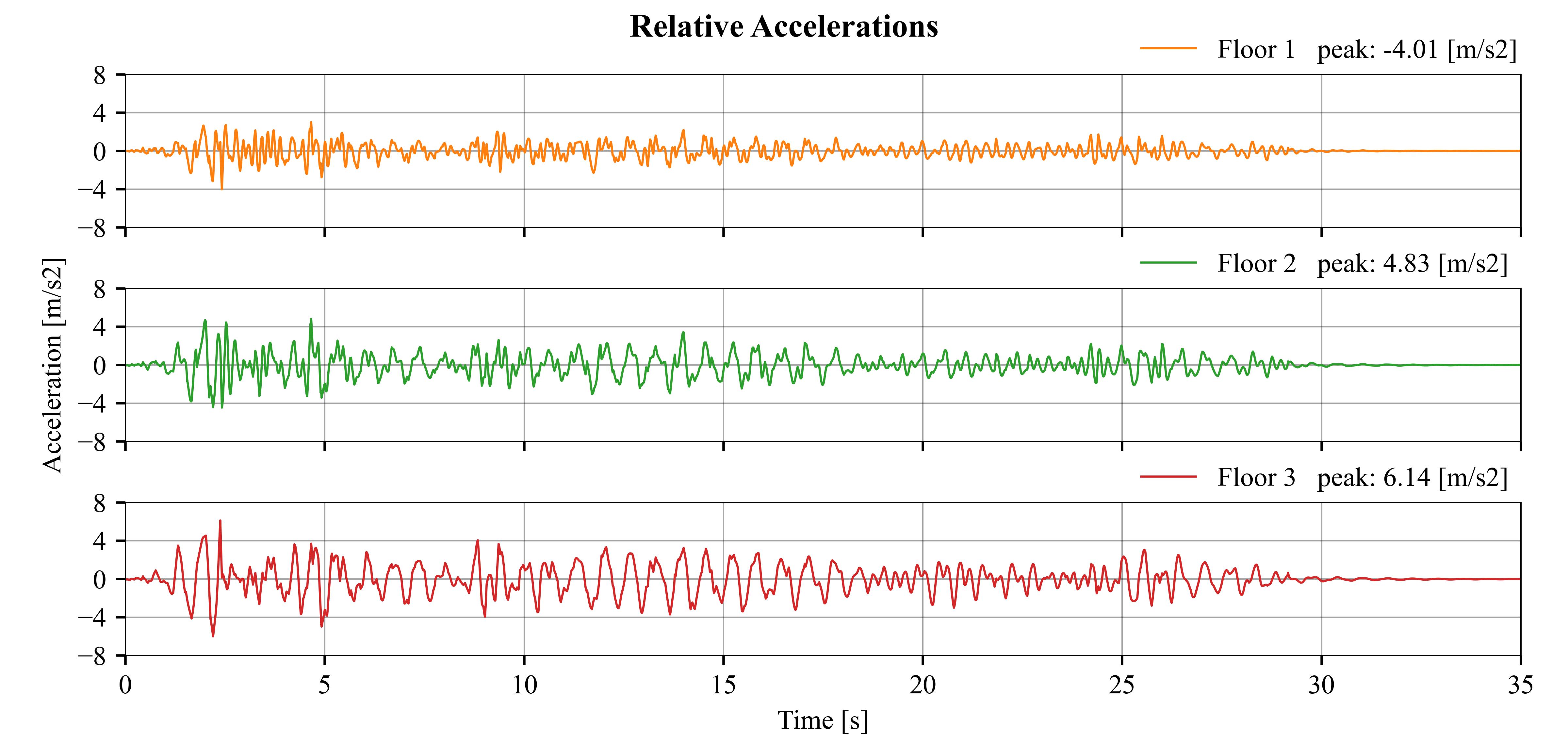
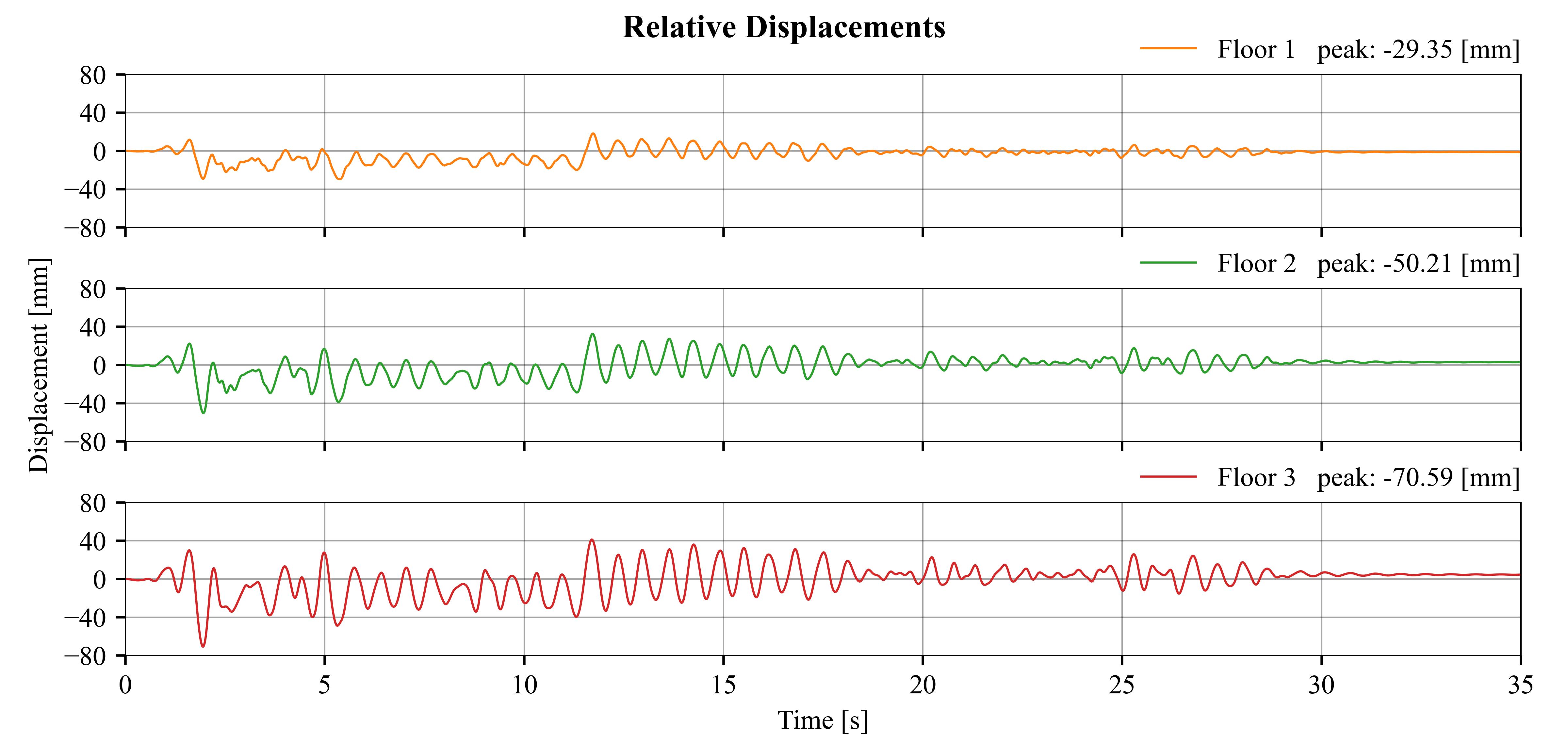
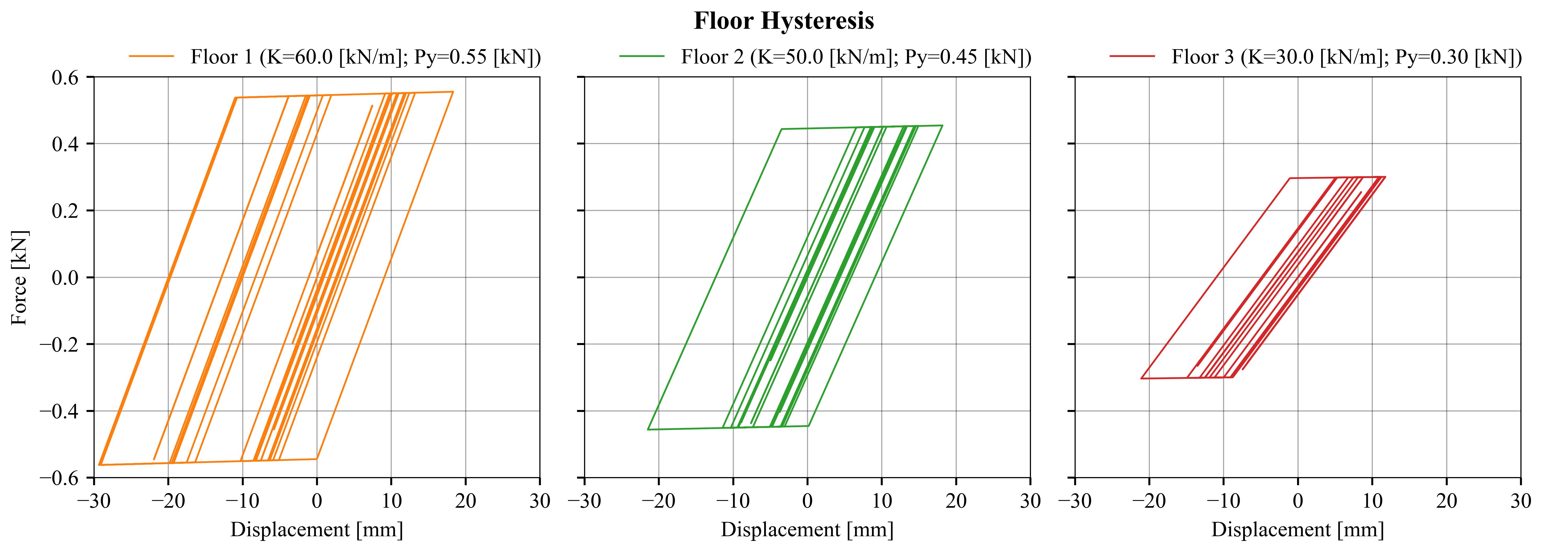
  1'''
  2=========================================================================================================================
  3================================================== NonLinear MDOF =======================================================
  4=========================================================================================================================
  5
  6By M. Eng. Joseph Jaramillo, National University of Engineering
  7e-mail: jjaramillod@uni.edu.pe
  8Date - 22/10/2024
  9
 10This example models a multi-degree-of-freedom (MDOF) damped system commonly used in earthquake engineering of a three-story
 11building. It conducts a nonlinear dynamic (time history)  analysis using the El Centro 1940 earthquake as the input ground
 12motion.
 13'''
 14
 15import openseespy.opensees as ops
 16import numpy as np
 17import plot_nonlinear_mdof_graphs
 18# Base units
 19m = 1                        # Meters
 20s = 1                        # Seconds
 21kN = 1                       # Kilo Newtons
 22
 23# Derivated units
 24g = 9.81*m/s**2              # Gravity
 25cm = 1e-2*m                  # Centimeter
 26mm = 1e-3*m                  # Milimeter
 27Ton = kN*s**2/m              # Ton
 28
 29# Parameters - data
 30N = 3                        # N° DOF
 31h = 0.05                     # Damping ratio
 32dt = 0.02                    # Time step
 33dt_out = 0.001               # Output time step
 34tFinal = 35                  # Analysis stop time
 35m1 = 0.1*Ton                 # Mass / floor
 36m2 = 0.1*Ton
 37m3 = 0.1*Ton
 38Py1 = 0.55*kN                 # Yielding strength / floor
 39Py2 = 0.45*kN
 40Py3 = 0.30*kN
 41K1 = 60*kN/m                 # Stiffness / floor
 42K2 = 50*kN/m
 43K3 = 30*kN/m
 44b = 0.01                     # Strain-hardening ratio
 45
 46######## Model ###############
 47ops.wipe()					                     # clear memory of all past model definitions
 48ops.model('basic', '-ndm', 1, '-ndf', 1) 		 # Define the model builder, ndm=#dimension, ndf=#dofs
 49
 50# Create nodes
 51ops.node(0, 0)
 52ops.node(1, 0, '-mass', m1)
 53ops.node(2, 0, '-mass', m2)
 54ops.node(3, 0, '-mass', m3)
 55
 56# Define boundary condition
 57ops.fix(0, 1)
 58
 59# Material definition
 60ops.uniaxialMaterial('Steel01', 1, Py1, K1, b)
 61ops.uniaxialMaterial('Steel01', 2, Py2, K2, b)
 62ops.uniaxialMaterial('Steel01', 3, Py3, K3, b)
 63
 64# Element definition
 65ops.element('zeroLength', 1, 0, 1, '-mat',    1   , '-dir', 1, '-doRayleigh', 1)
 66ops.element('zeroLength', 2, 1, 2, '-mat',    2   , '-dir', 1, '-doRayleigh', 1)
 67ops.element('zeroLength', 3, 2, 3, '-mat',    3   , '-dir', 1, '-doRayleigh', 1)
 68
 69# Set Rayleigh damping
 70w1, w2, w3 = np.array(ops.eigen('-fullGenLapack', 3))**0.5
 71a0 = 2*h*w1*w2/(w1+w2)
 72a1 = 2*h/(w1+w2)
 73ops.rayleigh(a0, .0, .0, a1)                     # RAYLEIGH damping
 74
 75# Natural periods
 76print('\nNatural periods:       Natural frequencies:')
 77print(f'T1 = {2*np.pi/w1:.3f} [s]    |    f1 = {w1/(2*np.pi):.3f} [Hz]')
 78print(f'T2 = {2*np.pi/w2:.3f} [s]    |    f2 = {w2/(2*np.pi):.3f} [Hz]')
 79print(f'T3 = {2*np.pi/w3:.3f} [s]    |    f3 = {w3/(2*np.pi):.3f} [Hz]')
 80
 81# Define the dynamic analysis
 82load_tag = 1
 83patter_tag = 1
 84direc = 1
 85ops.timeSeries('Path', load_tag, '-dt', dt, '-filePath', r'./el_centro.th', '-factor', g)                                           # Reading ground motion
 86ops.pattern('UniformExcitation', patter_tag, direc, '-accel', load_tag)
 87
 88# Define output data files
 89rD_path =  r'./Relative_disp.out'
 90ops.recorder('Node', '-file', r'./Relative_disp.out', '-time', '-dT', dt_out, '-node', 1, 2, 3, '-dof', 1, 'disp')                  # Relative displacements with respect to the ground
 91
 92rA_path =  r'./Relative_accel.out'
 93ops.recorder('Node', '-file', rA_path, '-time', '-dT', dt_out, '-node', 1, 2, 3, '-dof', 1, 'accel')                                # Relative accelerations with respect to the ground
 94
 95aA_path =  r'./Absolute_accel.out'
 96ops.recorder('Node', '-file', aA_path, '-timeSeries', load_tag, '-time', '-dT', dt_out, '-node', 0, 1, 2, 3, '-dof', 1, 'accel')    # Absolute accelerations
 97
 98eF_path =  r'./Element_force.out'
 99ops.recorder('Element', '-file', eF_path, '-time', '-dT', dt_out, '-ele', 1, 2, 3, 'localForce')                                    # Local spring force
100
101# Run the dynamic analysis
102Gamma = 0.5
103Beta = 0.25
104tol = 1.0e-12
105itrs = 100
106ops.wipeAnalysis()
107ops.algorithm('Newton')
108ops.system('BandGen')
109ops.numberer('Plain')
110ops.constraints('Plain')
111ops.integrator('Newmark', Gamma, Beta)
112ops.analysis('Transient')
113ops.test('NormUnbalance', tol, itrs)
114num_steps = int(tFinal/dt_out+1)
115ops.analyze(num_steps, dt_out)
116ops.wipe()
117
118rD = np.genfromtxt(rD_path, usecols=[1, 2, 3]).T
119
120rA = np.genfromtxt(rA_path, usecols=[1, 2, 3]).T
121aA = np.genfromtxt(aA_path, usecols=[1, 2, 3, 4]).T
122
123eF = np.genfromtxt(eF_path, usecols=[1, 2, 3]).T
124
125
126# Matplotlib plots
127rD /= mm
128K = [K1, K2, K3]
129Py = [Py1, Py2, Py3]
130plot_nonlinear_mdof_graphs.plot(N, rD, rA, aA, eF, dt_out, num_steps, tFinal, K, Py)